CreditMiner
Predicts credit-card default on 30,000 clients and explains why, from Weka models to a Next.js dashboard.
Team leader and main developer · data, models, API, dashboard, report · 2026 · Live
01 · The problem
The problem
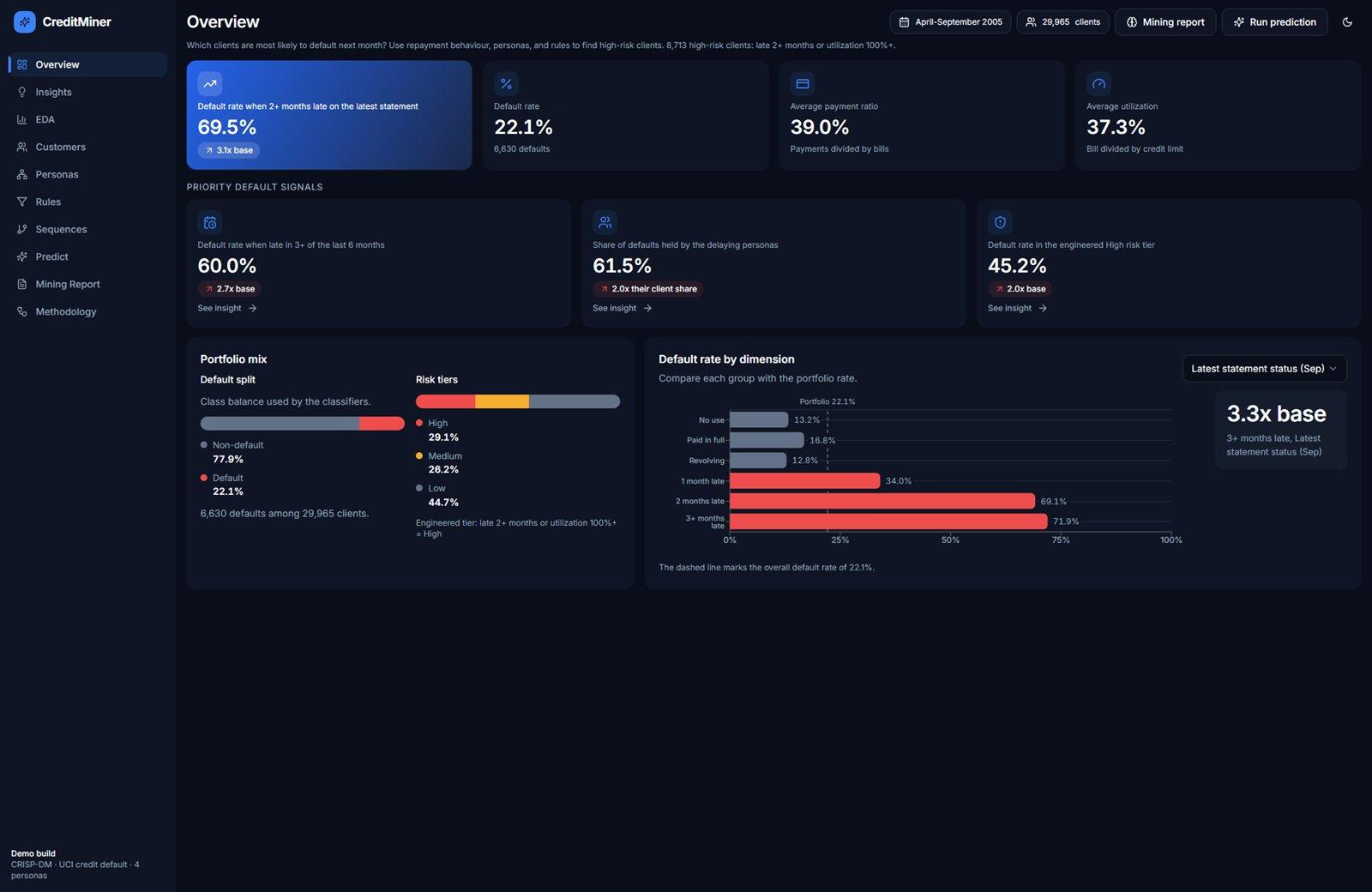
A card issuer wants to know, before the next statement, which clients are likely to default and which behaviours drive that risk. The UCI Default of Credit Card Clients dataset holds 30,000 clients with six months of statements, payments and repayment status; 22.1% defaulted the next month.
02 · The data
The data
UCI dataset 350 (Yeh and Lien, 2009): 29,965 clients after cleaning (35 duplicates removed), with IQR and z-score outlier flags and seven engineered features: utilization, payment ratio, months delayed, longest delay, bill trend and a risk tier.
03 · The approach
The approach
A stratified 80/20 split and ten Weka classifier variants (J48, random forest, naive Bayes, logistic regression; baseline, SMOTE and cost-sensitive) with 10-fold cross-validation and permutation importance. Then K-means personas (k = 4 from ten k-means++ restarts) with a PCA view, Apriori rule families and GSP repayment sequences. Every headline number is a traceable fact served by one API to the dashboard, the web report and a 28-page academic PDF.
04 · The results
The results
Random forest with cost-sensitive learning: holdout F1 0.533, ROC AUC 0.777, PR AUC 0.550. Clients two or more months late on the latest statement default at 69.5%, 3.1x the portfolio rate. Two delaying personas are 30.5% of clients but hold 61.5% of defaults. 183 backend tests, 209 web tests and a Playwright layout and contrast gate.
05 · Why it matters
Why it matters
Shows the full path from raw data to a decision tool a credit manager could use, with every number traceable and tested.
Gallery
Through the DABM lens
- DData
- 29,965 clients · six months of statements and repayments
- AAgent
- credit managers deciding who to call before the next statement
- BBehavior
- repayment delays and utilization that signal default
- MModeling
- cost-sensitive random forest · K-means personas · Apriori and GSP patterns
Stack
- Java 21
- Spring Boot
- Weka
- Next.js
- TypeScript
- PostgreSQL
- Playwright
A fuller case study for this project is coming soon.